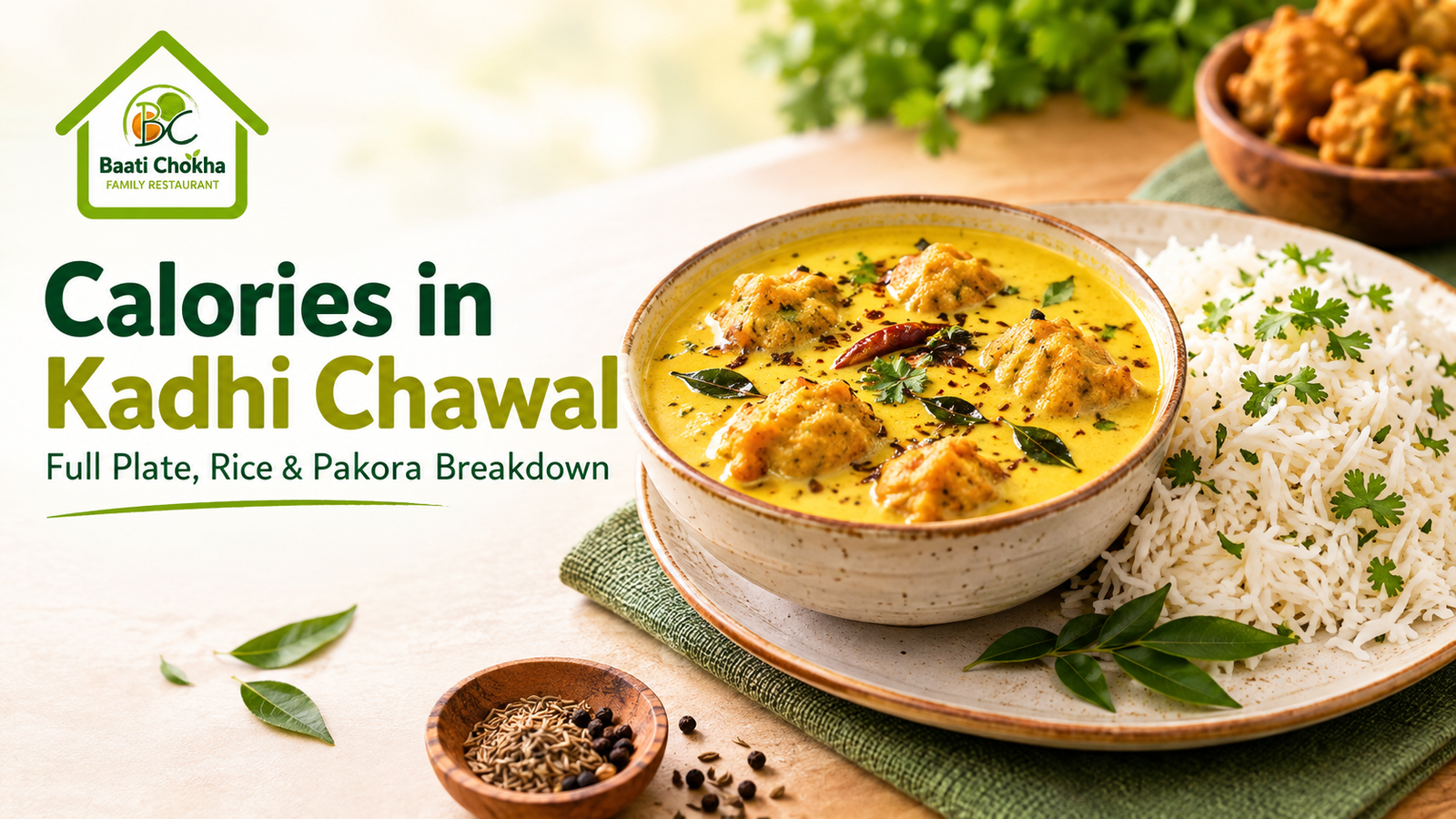
Quick answer: A typical home-cooked plate of kadhi chawal with pakoras has about 450 to 550 calories. Without pakoras, it comes to roughly 330 to 400 calories. The exact number depends on how much rice you eat, how many pakoras go in, and how much ghee is in the tadka.
If you’re tracking calories, you’ve probably noticed that most apps give one vague number for “kadhi chawal.” That isn’t much help, because a small bowl with 4 pakoras and a big dhaba-style plate with a mountain of rice can differ by 300 calories or more.
This guide breaks down the calories in kadhi chawal piece by piece (kadhi, pakoras, rice and tadka) so you can work out what’s on your plate. If you want to cook it first, here’s our full kadhi chawal recipe.
In this post:
- Calories per plate, per katori and per 100 g
- Calorie breakdown by ingredient
- How rice type and portion change the total
- Home-cooked vs restaurant kadhi chawal
- Macros: carbs, protein and fat
- Simple ways to cut calories without losing taste
- FAQs
Calories in One Plate of Kadhi Chawal
Here are the numbers for a standard serving: 1 katori kadhi (about 200 ml), 4 pakoras and 1 cup cooked rice.
| Version | Approx. calories |
| Kadhi chawal with pakoras (home-style) | 450 to 550 kcal |
| Kadhi chawal without pakoras | 330 to 400 kcal |
| Light version (air-fried pakoras, ¾ cup brown rice, 1 tsp ghee) | 300 to 350 kcal |
| Restaurant or dhaba plate | 600 to 750 kcal |
These are estimates. Curd type, besan quantity, oil absorption and serving size all shift the figure, so treat the ranges as a guide rather than a lab result.
Calorie Breakdown by Component
The calories in kadhi chawal come from four parts. Here is how they add up for one serving of our home recipe (serves 4).
| Component | What’s in it | Approx. calories per serving |
| Kadhi base | Curd + besan + water + spices | 80 kcal |
| Tadka | Ghee, jeera, hing, chilli | 40 to 45 kcal |
| Pakoras (4 medium) | Besan, onion, spices, frying oil | 120 to 160 kcal |
| Cooked white rice (1 cup, ~160 g) | Basmati or regular | 200 to 210 kcal |
| Total with pakoras | ~450 to 500 kcal | |
| Total without pakoras | ~330 to 340 kcal |
Kadhi alone
The gravy itself is not very high in calories. A katori of plain kadhi is mostly water, with calories coming from a modest amount of curd and besan. Expect about 80 to 130 kcal per katori, depending on how thick you make it and how much tadka goes in.
Pakoras
Pakoras are where calories climb. Each medium onion-besan pakora is roughly 30 to 45 kcal, and they absorb a lot of frying oil. Four pakoras add 120 to 160 kcal, and a generous helping of 8 doubles that. If you eat kadhi mainly for the pakoras, count them first.
Rice
Rice is usually the largest single contributor. One cup of cooked white rice has around 200 to 210 kcal. Many people serve themselves 1.5 to 2 cups without noticing, which adds another 100 to 200 kcal.
Tadka
A teaspoon of ghee has about 45 kcal, and a tablespoon has roughly 120. A tadka looks small, but restaurant versions often use several tablespoons per pot, which adds up.
Kadhi Chawal Calories per 100 g
If you weigh your food, these per-100 g values help:
| Item | Approx. kcal per 100 g |
| Kadhi (without pakoras) | 45 to 65 kcal |
| Kadhi with pakoras | 90 to 130 kcal |
| Cooked white rice | 130 kcal |
| Cooked brown rice | 110 to 120 kcal |
| Fried kadhi pakoras | 250 to 320 kcal |
| Besan (dry) | about 370 kcal |
| Ghee | about 900 kcal |
Weigh your cooked rice once with a kitchen scale and you’ll know what “one cup” really looks like on your plate. Most people are surprised.
How Rice Type and Portion Change the Calories
Rice choice and quantity change your total more than almost anything else on the plate.
| Rice | Portion (cooked) | Approx. calories |
| White rice | ¾ cup | 150 to 160 kcal |
| White rice | 1 cup | 200 to 210 kcal |
| White rice | 1½ cups | 300 to 315 kcal |
| White rice | 2 cups | 400 to 420 kcal |
| Brown rice | 1 cup | 175 to 215 kcal |
| Jeera rice (with ghee) | 1 cup | 240 to 270 kcal |
Brown rice isn’t dramatically lower in calories than white. Its advantage is more fibre, which keeps you full longer. Jeera rice tastes great with kadhi but adds roughly 40 to 60 kcal per cup because of the ghee.
Home-Cooked vs Restaurant Kadhi Chawal
Restaurant kadhi chawal usually has more calories, for three reasons:
- More oil and ghee. Restaurant kitchens temper generously and often finish with extra butter or ghee.
- Full-fat curd or cream. Some restaurants add malai for richness.
- Bigger portions. A thali-style rice serving can easily be 1.5 to 2 cups.
A home-cooked plate usually sits at 450 to 550 kcal, while a restaurant or dhaba plate commonly reaches 600 to 750 kcal. If you order out often, ask for less rice or skip the extra tadka on top.
Macros: Carbs, Protein and Fat in Kadhi Chawal
For a standard home-cooked plate with pakoras (roughly 500 kcal), expect:
| Nutrient | Approx. amount |
| Carbohydrates | 60 to 75 g |
| Protein | 10 to 14 g |
| Fat | 14 to 20 g |
| Fibre | 3 to 5 g |
Kadhi chawal is carbohydrate-heavy because of rice and besan. It does offer some protein from besan and curd, and it can be a reasonable meal when paired with vegetables. If you’re managing blood sugar, it’s worth keeping rice portions modest and adding a salad or sabzi. People with diabetes or other conditions should confirm portions with their doctor or dietitian.
Why Do Online Calorie Numbers Differ?
You might see anything from 250 to 700 kcal for kadhi chawal on different websites and apps. That’s because:
- Some figures count only kadhi and rice with no pakoras
- Serving sizes aren’t standardised (“one bowl” can mean 150 ml or 350 ml)
- Oil absorption in pakoras varies a lot
- Restaurant and home recipes use very different amounts of fat
Use the component method above, since it adapts to your own cooking.
How to Calculate Calories for Your Own Plate
- Weigh or measure the rice. Use the table above.
- Count the pakoras. Use roughly 30 to 45 kcal each.
- Measure the kadhi. A level katori of 200 ml is about 100 kcal.
- Add the tadka. About 40 kcal per serving, or more if you’re generous.
- Add sides. Roasted papad adds around 35 kcal, fried papad about 60, and pickle about 20 per spoon.
Example: 1 cup white rice (205) + 1 katori kadhi (100) + 5 pakoras (190) + roasted papad (35) = about 530 kcal.
How to Reduce Calories in Kadhi Chawal
You can lower the calories by 150 or more without making the meal taste like diet food.
- Air-fry or steam the pakoras. This can save 50 to 80 kcal per plate. Our guide to soft kadhi pakoras has the technique.
- Cut the rice, not the kadhi. Move from 1½ cups to ¾ cup and add salad or lauki sabzi.
- Use toned-milk curd. It reduces fat without hurting the tang.
- Reduce the tadka to 1 tsp ghee for four servings.
- Add vegetables like lauki, spinach or carrot to the gravy for volume and fibre.
- Use brown rice or millets such as jowar or bajra for better fullness.
- Choose roasted papad over fried.
- Eat the pakoras last, if you eat them at all. You’ll fill up on kadhi and rice first.
Together, these changes can bring a plate down to about 300 to 350 kcal. For a deeper look, read Is Kadhi Chawal Good for Weight Loss?
Kadhi Chawal vs Other Indian Rice Meals
How does it compare with other everyday rice-based meals (approximate, per plate with 1 cup rice)?
| Meal | Approx. calories |
| Dal chawal | 350 to 450 kcal |
| Kadhi chawal (with pakoras) | 450 to 550 kcal |
| Rajma chawal | 450 to 550 kcal |
| Chole chawal | 500 to 600 kcal |
Kadhi chawal lands in the middle. It’s lighter than chole chawal but heavier than a simple dal chawal because of the pakoras and ghee. See our full comparison in Kadhi Chawal vs Dal Chawal vs Rajma Chawal.
Frequently Asked Questions
How many calories are in kadhi chawal?
A typical home-cooked plate with pakoras has about 450 to 550 kcal. Without pakoras it’s about 330 to 400 kcal.
How many calories are in one bowl (katori) of kadhi?
A katori of plain kadhi has roughly 80 to 130 kcal. With 4 pakoras it rises to about 200 to 270 kcal.
How many calories are in one kadhi pakora?
About 30 to 45 kcal, depending on size and how much oil it absorbs.
Is kadhi chawal high in calories?
It’s moderate. It isn’t especially high, but it can become calorie-dense when you add many fried pakoras, lots of ghee and a large portion of rice.
Is kadhi chawal good for weight loss?
It can fit into a weight-loss diet if you control portions, limit fried pakoras and keep the tadka light. A lighter plate of around 300 to 350 kcal works well with most calorie-controlled plans.
Is kadhi without pakoras lower in calories?
Yes. Skipping pakoras saves roughly 120 to 160 kcal per plate.
Does brown rice reduce the calories in kadhi chawal?
Only slightly. The main benefit of brown rice is more fibre, which helps you feel full.
How much protein does kadhi chawal have?
Roughly 10 to 14 g per plate, from besan and curd.
Is kadhi chawal good for diabetics?
Rice and besan raise blood sugar, so portions matter. Brown rice, smaller servings and added vegetables can help, but check with your doctor or dietitian for advice that fits your health needs.
Can I eat kadhi chawal at night?
You can. Choose a smaller rice portion and skip heavy pakoras if you’re eating late.
Final Thoughts
The calories in kadhi chawal aren’t a fixed number. For most home-cooked plates, 450 to 550 kcal is a safe estimate, and you can bring it close to 300 by cutting rice, air-frying pakoras and lightening the tadka. Measure the main components once, and you’ll be able to enjoy this classic without guessing.
Ready to cook it? Head to our kadhi chawal recipe, or explore more homestyle recipes on Baati Chokha.